The Victoria and Albert Museum Silver Filigree Purse.
17th Century Nuremburg.


Width 7.4 cms.
Originally in the collection of Lord Zouche.
Acquired in 1891.
The Victoria and Albert Museum Silver Filigree Purse.
17th Century Nuremburg.
Width 7.4 cms.
Originally in the collection of Lord Zouche.
Acquired in 1891.
19th Century Photograph of a Silver Filigree Plate or Tray
from the Rijksmuseum.

c. 1855 - before 1863.
From an Album : collection of images of the most remarkable objects,
submitted for the exhibition of antiquities, held in Delft, in July and August
1863.
A Miniature Silver Filigree Candlestick.
17th /18th Century.
English?
From a private Collection -

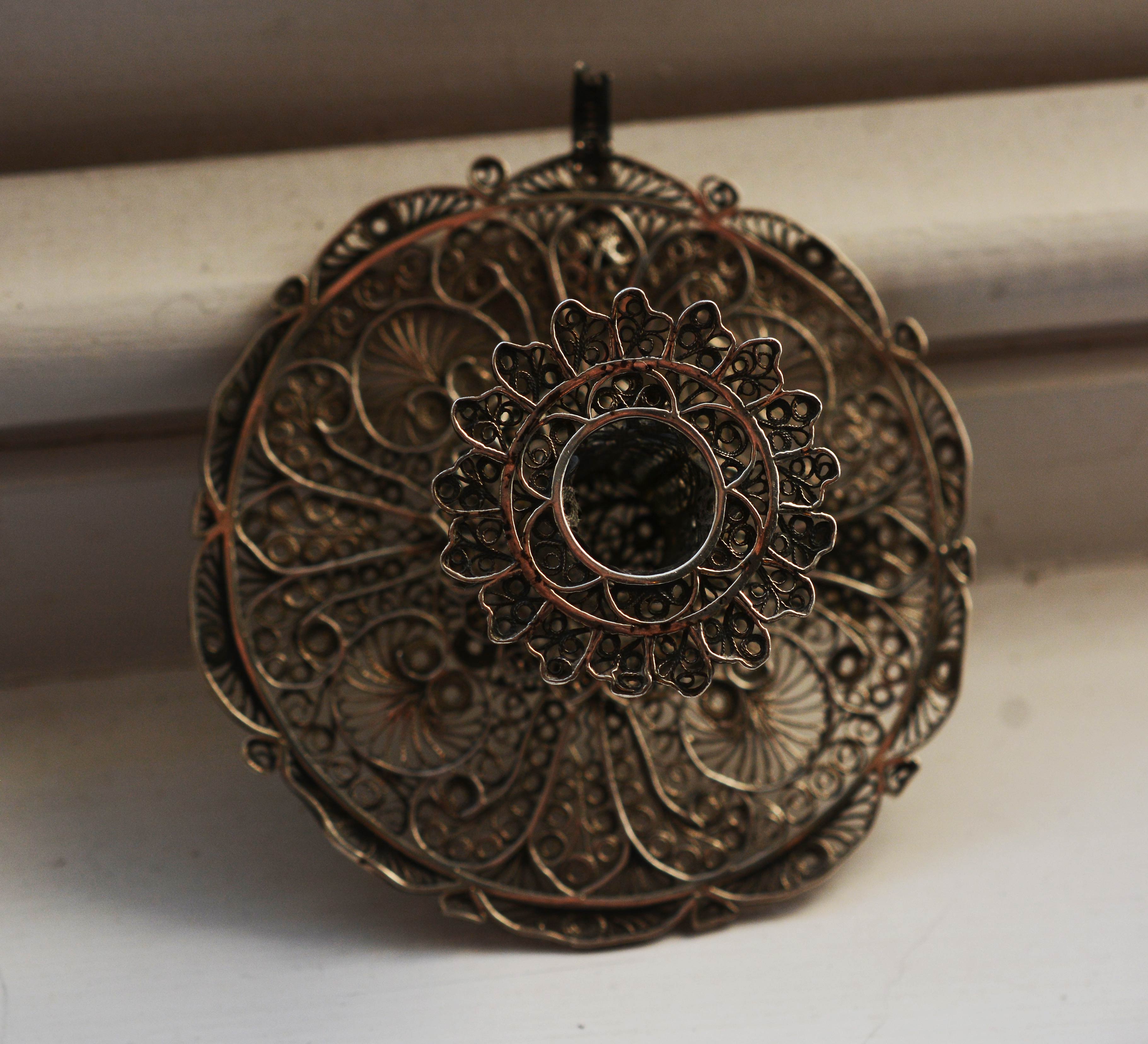

Size approx 7 cms diam.
_____________________
A Pair of Silver Filigree Miniature Candlesticks -
Chatsworth House
Details to be confirmed.

Three Silver Filigree Zarfs?
(Post in preparation).
from a private collection.
Zarfs are Cup Holders for Turkish Coffee.
These three cup holders are of indeterminate date - and unknown country of origin.
all three are of exquisite quality but the style of workmanship is quite different on each one.


Diam approx 7cms.


All three objects here are from a private Collection -
They are all unmarked.


Size approx. 7 cms diam.
__________________
Photograph of Two Zarfs from the archives of KAM, Vienna.
c. 1880's.
Unknown location - the coffer appears to be that now in the Hesse Kassel Collection.
see my post - https://antiqueeuropeanfiligree.blogspot.com/2023/02/silver-filigree-casket-museum-von.html

__________________
The two Liechtenstein Collection Zarfs.

Diam 4 cms.
Acquired in 1881 by Prince Johann II von Liechtenstein.

Diam 3.5 cms.
Acquired in 1881 by Prince Johann II von Liechtenstein.
The collection website suggests Italian.


One of Three matching Zarfs?
Antique Arena Inc. Brooklyn, NY, US.
Lot 146, November 5, 2022.
_____________
Two Zarfs Illustrated in the online Ascas Newsletter posted in March 2007.
Two Silver Filigree and enamel Zarfs.
I suspect that these are Russian late 19th Century.
"The zarf on the right has got a (later made) inner silver cup with a
handle (charka) with Moscow marks of 1791. The inner cup also has a screw in
the bottom. The Zarf itself has no marks and it is fastened to the cup´s screw
with a nut.


https://www.ascasonline.org/newsMARZ35.html
_______________
The Burghley House Filigree Bowls.
They suggest that this is a toilet set but I believe that these pieces probably didn't all start life together.
The two bowls illustrated below - are not a pair.
I will return to the Burghley pieces in due course


https://collections.burghley.co.uk/collection/a-silver-filigree-toilet-service/
___________________
Set of Six Chinese Export Silver Gilt,Silver Filigree and Enamel Zarfs.
previously with London dealer Michael Backman.


Described as Southern China for the Ottoman Market
Circa 1860.
The interior of the base of each is fixed with a small
silver plaque that has the ‘Gothic K’ maker’s mark alongside a faux Chinese
ideogram.
Height: 5.1cm, width: 4.6cm.
Text and photographs from -
https://www.michaelbackmanltd.com/object/chinese-export-silver-ottoman-zarfs/
I am very grateful to Michael Backman for permission to use his photographs.
Karimnagar and Some 19th Century Silver Filigree Objects.
Essay from the Indian Journal of Traditional Knowledge - Vol 4 October 2005.
This essay suggests that Mr Kadarla Ramayya introduced the manufacture of filigree at Karamnagar about 160 years ago.
The first reference I can find to Kadarla Ramayya and filigree at Karimnager is in 1972 and repeats the assertions in this essay - so perhaps not entirely to be trusted.
https://nopr.niscpr.res.in/bitstream/123456789/8525/1/IJTK%204(4)%20386-391.pdf
The two objects here are in the Salar Jung Museum in Hyderabad, India.
They are probably 19th Century but it is possible they could be earlier and that they did not originate in Karimnagar but came from Cuttack, Orissa, the workmanship appears very close to known objects from Karimnager.


https://www.facebook.com/photo/?fbid=2704128413135849&set=a.1556996821182353
...........................


Currently no sizes available and it is therefore it is not immediately obvious whether these pieces are closely related, but it is possible that they were part of a two piece set.
Images here from
https://salarjungmuseum.in/Indian-Silver.html
--------------------
The Victoria and Albert Museum Set of Filigree Caskets and Tray.
Given to the South Kensington Museums by Prince Albert in 1857.
Madras Exhibition 1857; Indian Museum, transferred to SKM
1879. Indian Museum slip book number 10,519: 'Tray, Hyderabad'.
Height: 90mm, Length: 230mm, Width: 185mm, Tray only height: 50mm
Height: 60mm (For large box in centre) Width: 117mm (For large box in centre) Depth: 70mm (For large box in centre)
https://collections.vam.ac.uk/item/O111687/spice-tray-unknown/
The feet on the tray are very similar to those on the two objects illustrated here
https://antiqueeuropeanfiligree.blogspot.com/2023/03/an-indian-silver-filigree-candle-holder.html


............................


.jpg)

For more examples of small caskets from Karimnagar see my post-
https://antiqueeuropeanfiligree.blogspot.com/2023/06/three-silver-filigree-boxes-karimnagar.html
For my essay on Gulab pash (rosewater sprinklers) from Cuttack and Karimnagar see -
https://antiqueeuropeanfiligree.blogspot.com/2023/09/silver-filigree-rosewater-sprinklers.html
...........................................
The Museum suggests an ornament possibly to cover a basket. Silver Filigree with Enamel Panels. c. 1680 - 1700. I suspect German although ...


